Modular homes are widely regarded for their rapid timeline to move-in as compared to traditional stick-built homes. With the bulk of the build taking place inside a controlled factory environment, weather delays and labor shortages have minimal impact. However, modular home builds are not entirely immune to delays. Understanding the most common causes for delay may help homebuyers to plan more effectively and put themselves in the best possible position to keep their build on track.
1. Permitting and Homebuyer Responsibilities
The most common reason for project delay occurs before construction even begins.
In order for the town to award a building permit, your property must first be surveyed and a Site Plan prepared by a civil engineering firm. The site plan is the responsibility of the homebuyer, and is the most common cause of project delay.
We, as the builder, must submit a current, updated site plan to town officials alongside our architecturally drawn plans. What many homebuyers don’t realize is just how long it actually takes for a site plan to be prepared. They may take 2, 3, or even 4 months to be completed by a civil engineering firm. Many modular homebuyers are so eager to get into designing and customizing their home that the site plan falls by the wayside, rather than being front-of-mind. However, in reality, the site plan should be a top priority for the homebuyer; we do not order the home from our factory until a building permit has been awarded, so failure to provide a site plan in a timely fashion will hold up your project.
There are other zoning-related challenges, too. While some towns may process permit requests quickly, others may require multiple reviews or planning board approvals. If the property requires subdivision, variances, septic approvals, wetlands reviews, or special zoning considerations, the permitting phase can extend the overall timeline significantly.
The best thing you can do in order to help minimize delays is to work with an experienced, knowledgeable, reputable partner that can bring these would-be pain points to light and assist you in navigating through them.
Pro Tip: Don’t be afraid to pepper your local Planning & Zoning Department with questions— connect with them early and often, as this will help to bring to light any potential headaches that you may face later on down the line.
2. Design Changes Following Approvals
Part of what makes modular homes so compelling is the enormous potential for customization. The design phase is very thorough and personal, which allows the Homebuyer to really take ownership of their custom home. However, there must come a time when revisions are no more and the floorplan is deemed final, at which time the factory will send the design for third-party processing to ensure compliance with state and local building codes. Once these approvals are met, which can take roughly six weeks, an official, certified, stamped plan will be delivered in both hard copy and PDF format.
While we make every effort to instill in homebuyers that the certified, stamped plans cannot be modified or customized further, it has proven difficult to completely stop the creative juices from flowing for up to six weeks. Design changes, whether large or small, that are submitted after a plan has already undergone state approvals will result in not just a delay of up to six weeks, but also an additional expense by way of a significant restamping fee.
In order to avoid process delays or additional expenses resulting from late-in-the-game design changes, we encourage homebuyers to really take their time and be thorough in their design reviews, so that we can be sure that the plan they deem final truly does mean final.
3. Site Preparation Challenges
It’s a rare occasion, but there are indeed scenarios in which on-site challenges may require us to push the delivery date of a home. Being in New England, severe winter weather is the usual culprit. An excavator can break ground so long as frost hasn’t permeated more than 18” down into the ground, and frost generally won’t do so unless we experience multiple consecutive weeks of “polar vortexes”. However, nothing’s impossible, as recent winters have proven.
If excavation cannot be completed on schedule, then the precast foundation system cannot be installed on schedule, then, depending on how much buffer we may have between foundation install and modular delivery, it’s possible that the modular set may need to be pushed. Rest assured, we invest much thought into our set planning and strategy, which has been extremely effective in minimizing this risk.
4. Weather During the Set
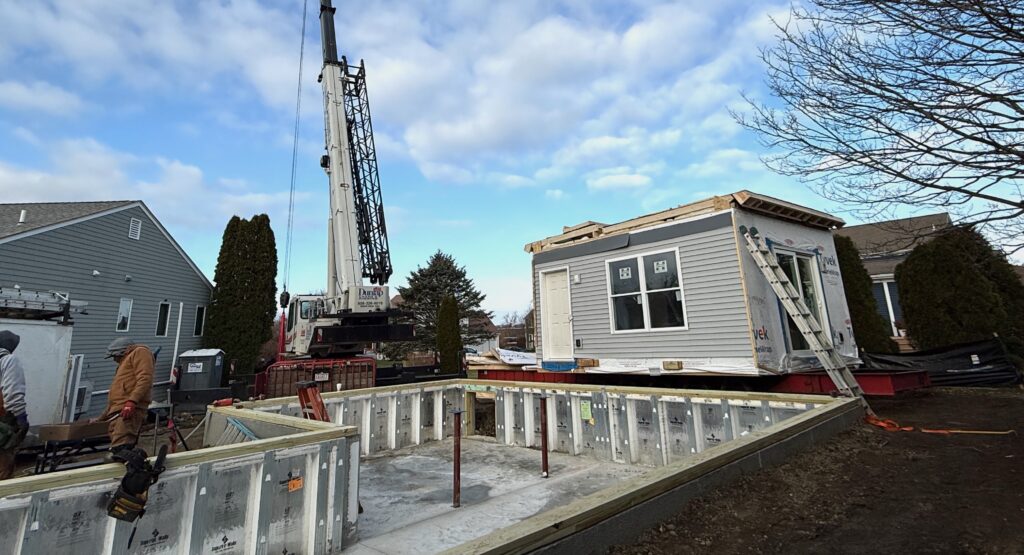
Although the home itself is built indoors, delivery and installation of course happens outdoors. High winds, torrential rain, or heavy snow can make it unsafe to transport modules or operate cranes. If poor weather occurs on the scheduled set day, the set may need to be pushed or rescheduled.
5. Inspection Scheduling
After the modules are set, there are still several steps before the home is move-in ready. Mainly, plumbing and electrical tie-ins, finish carpentry, and inspections. The complete post-set punch list is detailed in the following article, Why You Can’t Move in Immediately After Your Modular Home is Finished.
Until the building inspector has been on-site and a Certificate of Occupancy (C.O.) has been awarded, the home cannot truly be considered “all yours.” In order to receive a C.O., all required approvals must be completed. While this generally happens quickly, inspection availability varies by town. If inspectors are booked out weeks in advance, the project may sit on hold just shy of the finish line until the final milestone, Certificate of Occupancy, has been achieved.
Planning Ahead to Reduce Delays
While some delays are unavoidable, like those posed by turns in the weather, risk of delays can still be minimized with proper planning. Working with an experienced builder and abiding by their given process structure is how you will best steer clear of delays and the associated headaches.
Modular construction offers many advantages in speed and efficiency, but, like any homebuilding project, timelines hinge on coordination between design, manufacturing, site work, and local approvals. Understanding these factors can help homeowners to set realistic goals and expectations, culminating in a smoother, more enjoyable homebuilding experience.