What is an ADU & Why the Law Changed
An Accessory Dwelling Unit (ADU) is a small secondary home on the same lot as a single-family house — often called an in-law apartment, granny flat, or backyard cottage.
Connecticut passed Public Act 21-29 in 2021 to increase housing supply and affordability. The law required towns to allow at least one ADU on single-family lots, subject to the following conditions:
- ADUs can be attached or detached.
- Maximum size of 1,000 sqft or 30% of the square footage of the primary dwelling, whichever less.
- Towns can’t require more than one parking space per ADU.
- Towns can’t restrict occupancy to family members.
The Opt-Out Provision
The law let towns opt out of these baseline rules by January 1, 2023. Opting out doesn’t mean banning ADUs entirely; it means the town can write its own regulations, which may be stricter or more flexible than the state standard.
If a town did not opt out, then the state’s baseline rules apply automatically.
How Many Towns Opted Out
Out of Connecticut’s 169 municipalities:
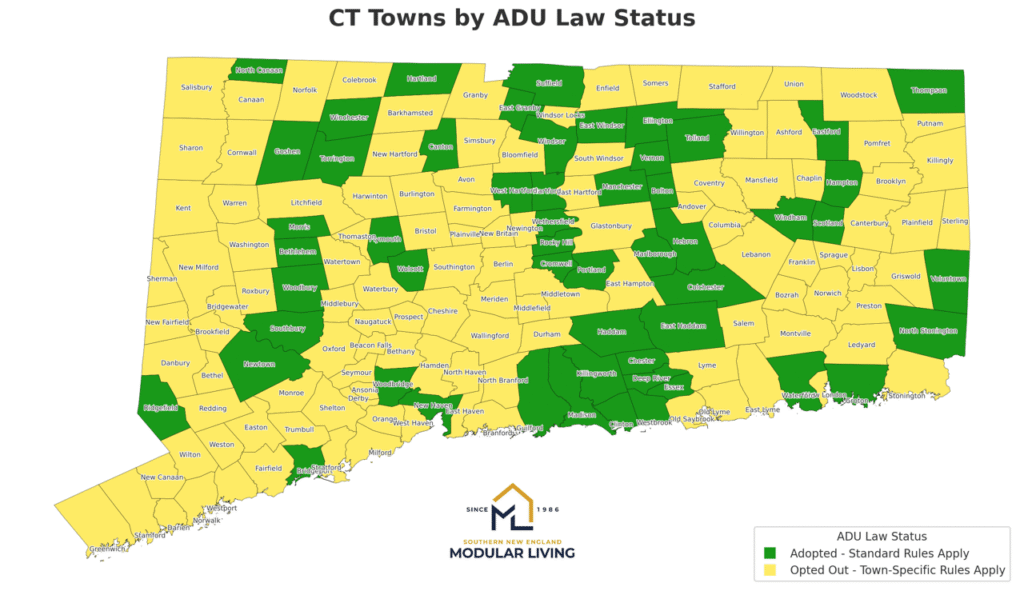
- 115 opted out
- 54 did not opt out
Even among opt-out towns, many allow ADUs under local rules.
Key Issues Driving Opt-Outs
- Protecting town “character” and density limits
- Septic and infrastructure concerns in rural areas
- Desire to keep local control over zoning
What Homeowners Should Do
- Check if your town opted out.
- Review local ADU regulations for size, setbacks, parking, and design requirements.
- If not opted out, follow state baseline plus local permitting.
- Meet with your zoning office early to avoid surprises.
- Budget for utilities, permits, and possible septic requirements.
What’s Next
There is ongoing debate in Connecticut about whether to reduce town-level barriers or eliminate opt-outs altogether. Housing advocates see ADUs as a key solution to affordability and supply, while many towns aim to balance that with local planning concerns. Our neighboring state of Rhode Island has passed sweeping zoning laws in favor of ADUs as recently as this year, so perhaps it won’t be long before Connecticut follows suit.